
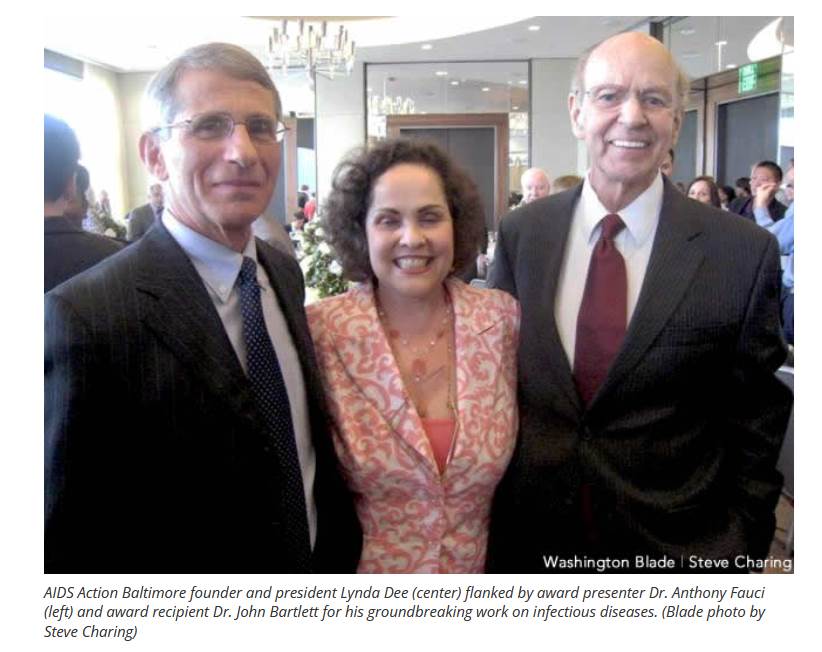
In Memoriam: John G. Bartlett, MD
By Richard E. Chaisson, MD
Dr. John Bartlett, an iconic and visionary leader in infectious diseases and HIV/AIDS died on January 19, 2021, at the age of 83. Dr. Bartlett was an original principal investigator in what became the AIDS Clinical Trials Group and a legendary scientist, clinician, teacher, and writer who made major contributions to an astonishingly wide range of infectious disease threats. In addition to his leadership within the ACTG, Dr. Bartlett played a pivotal role in leading numerous other professional and public health entities, including co-chairing the Department of Health and Human Services HIV Guidelines Panel, serving as president of the Infectious Diseases Society of America, and chairing the board of directors of Baltimore’s Health Education Resources Organization (HERO), one of the earliest AIDS advocacy groups in the country.
Born in upstate New York, John studied medicine at SUNY Syracuse, was an intern at the Peter Bent Brigham Hospital in Boston, and a resident at the University of Alabama, Birmingham, where he planned to become a cardiologist. He was drafted into the US Army in 1965 and sent to Vietnam where he helped run a hospital that cared for soldiers with a variety of infections. Returning to the US, he decided to study infectious diseases because “you can look in the microscope and see the enemy.” He began studying anaerobic infections and helped elucidate the causes of both pulmonary and abdominal infections caused by anaerobes, publishing a number of seminal papers on the subject. He then focused his attention on antibiotic-associated colitis, and discovered the toxin produced by Clostridium difficile (C. diff) that caused the disease. His landmark study of C. diff colitis, published in the New England Journal of Medicine, led to the development of diagnostic tests and treatments for this extremely common and debilitating disease.
John was recruited to Johns Hopkins School of Medicine in 1980 to lead the Infectious Disease division and over the next 26 years built it into a global leader across the entire spectrum of infectious diseases. In 1982, his interests shifted to the AIDS epidemic and he and his colleague Frank Polk mobilized resources within the institution to both care for patients and better understand the disease. He created the second dedicated inpatient AIDS ward in the world, after San Francisco General Hospital, and recruited a multidisciplinary team of clinicians to provide care and develop treatments.
Over the next 30+ years he became an internationally renowned expert in HIV therapeutics, always driven by his own direct involvement in caring for patients. John maintained a busy clinic caring for people with HIV and other infections, taught on the inpatient wards, and always attended on the AIDS Ward on Christmas, giving gifts to every patient while wearing a Santa hat. He befriended Garey Lambert, a prominent local AIDS activist who had written highly critical articles about the medical community’s response to the epidemic. John and Garey became close friends; Garey relied on John’s insights into HIV research, and John brought Garey to scientific meetings, including ACTG meetings, to both learn and provide community perspective to researchers and clinicians. Following Garey’s death, the Hopkins HIV Research Clinic was named in his honor, and a large portrait of Garey hung over John’s desk for the remainder of his career.
John was one of the most sought-after speakers on HIV and infectious diseases. He lectured around the world with an absolutely brilliant ability to synthesize data, explain it to scientists, clinicians, and laypeople, and look into the future to predict what would come next. John’s Top Ten lists of advances in HIV and Infectious Diseases were extremely popular talks at conferences and have been emulated by many. He was an early adopter of internet tools, establishing an HIV website, conducting online clinical conferences for clinicians in Ethiopia, Uganda, and India, and pioneering telemedicine for inmates in the Maryland state prison system. His teaching in the classroom and at the bedside was equally awe-inspiring, with his encyclopedic knowledge and insightful interpretation. He wrote prodigiously, producing dozens of books, including his Pocket Guide to HIV Infection and The Medical Management of HIV Infection, now in their 19th and 17th editions, respectively. In addition to HIV, he was a leader in areas as diverse as bioterrorism, emerging infections, community-acquired pneumonia, and antimicrobial resistance.
John was famed for his extraordinary work ethic, maintaining a schedule that made most people weary just to think about. He arrived at his office in the wee hours of the morning and worked for 15 hours, but still managed to be home for dinner and spend the evening with his wife Jean and their three children, Valerie, Josh, and Scott. He explained his secret to me once when he returned from a two-week vacation with Jean in Australia and showed me the hand-written manuscript he had produced while they were there, the first edition of his Pocket Guide to HIV/AIDS. I scolded him and told him he was supposed to have been on vacation, and he responded, “Yes, but you have to understand that Jean sleeps at night.” In addition to time spent with his family, John was a talented artist, and he once took a sabbatical to Paris to paint.
Following his retirement in 2014, John and Jean moved to Tupelo, Mississippi, where he continued to write, read, lecture, and serve on committees, but he was able to spend even more time with friends and family. John’s beloved wife Jean Bartlett died in October, 2020.
In 2016 the Johns Hopkins HIV and viral hepatitis clinics were merged in a magnificent new facility named The John G. Bartlett Specialty Practice. The clinic continues the work that John began 36 years ago, caring for people from all walks of life with HIV infection.
John’s death is a huge loss to the HIV and medical communities. He commented at his retirement, “It would be difficult to find another discipline in medicine that has such extraordinary diversity, surprises, value in patient care, and clinical relevance for both domestic and international applications.”1 It would be difficult to name another individual who contributed more to our understanding of, provided better care for, or helped educate more practitioners to combat the diverse spectrum of microbes that threaten human health and happiness than John Bartlett.
_____________________________________
1 Bartlett JG. Why infectious diseases. Clin Infect Dis. 2014, 59(suppl 2):S85–S92,
AIDS Action Baltimore forces Moderna and Pfizer to include people in their COVID-19 Vaccine Trials
COVID-19 Vaccine Trial Advocacy Letter to Moderna
https://www.aidsactionbaltimore.org/wordpress/wp-content/uploads/2020/07/COVID-19-Vaccine-Trial-Advocacy-Letter.pdf
COVID-19 Vaccine Trial Advocacy Letter to Pfizer
https://www.aidsactionbaltimore.org/wordpress/wp-content/uploads/2020/08/Pfizer-Vaccine-Trial-HIV-HBV-HCV-Exclusion-Letter.pdf
amFAR Article
https://www.amfar.org/Vaccine-Trial-Victory/
Bloomberg Article
https://www.bloomberg.com/news/articles/2020-08-06/moderna-backtracks-to-open-covid-vaccine-trial-to-those-with-hiv?sref=9f0rXTjL
POZ Article
https://www.poz.com/article/will-people-hiv-excluded-covid19-vaccine-trials
Science Magazine Article
https://www.sciencemag.org/news/2020/08/groups-protest-exclusion-hiv-infected-people-coronavirus-vaccine-trials

AIDS ACTION BALTIMORE, INC.
14 EAST EAGER STREET, BALTIMORE, MARYLAND 21202
(410) 837-2437, FAX (410) 837-2438
BaltoAIDS@aol.com http://aidsactionbaltimore.org

Dear Friends:
AIDS Action Baltimore (AAB) has been providing essential services to our community since 1987. Thanks to your generosity, we’re still standing. We all know only too well that times are still tough, but as we commemorate our 36th year of service, we hope we can count on your continued support which will help us maintain our many HIV/AIDS programs. We still desperately need your help to keep our doors open and continue to provide our many essential services to the Baltimore HIV/AIDS community. We hope you will remember us and continue your loyal support. Please help us in any way you can. Your donations will enable us to continue our marvelous record of benevolence and compassion with only a rate of 5.9% overhead in 2022. The amount of work we accomplish and the effect we have had on the war against HIV with only four employees is truly amazing!
Although HIV disease is becoming a chronic manageable disease, here is why we still need your help now more than ever:
AAB still provides financial assistance to many needy PWHIV/AIDS. AAB has provided this support to over 8,900 people since 1987 and $3,246,000 in assistance for items such as rent and utilities, and direct programs in our community to PWHIV/AIDS and their families. We firmly believe we must continue our invaluable financial assistance program which provides a safety net to PWHIV/AIDS experiencing an emergency financial crisis.
In the latest Centers for Disease Control (CDC) data reported in 2022, Maryland was ranked 12th among U.S. states and territories in adult/adolescent HIV diagnosis rates (per 100,000) in 2021. At year end of 2022, there were 31,616 people aged 13 and older living with diagnosed HIV in Maryland. An estimated 3,200 PWHIV/AIDS in Maryland in 2021 remain undiagnosed.
AAB has been instrumental again this year in reducing HIV transmission in Baltimore. According to the CDC, the lifetime risk of HIV is one in 22 for Black males, one in 51 for Latinx males, and one in 140 for White males. We are currently administering an HIV PrEP prevention program, known as New Horizons. PrEP is a one pill, once a day pill that has proven to be 99% effective in reducing HIV transmission risk. Our HIV prevention program provides outreach, education, testing assistance, healthcare linkages, navigation support and support groups that promote medication adherence for Black Transgender (Trans) people and Gay men at risk of HIV, and also for people who are HIV positive. We also provide our clients with the latest in HIV prevention and treatment research information.
New Horizons promotes a continuum of care, HIV prevention and/or HIV treatment including retention in care and adherence to life-saving medications in LGBTQIA+ people as well. Our prevention and treatment efforts have been extremely successful. We seek to educate Black Gay men and Trans people about their exorbitant risk of HIV transmission, and help them build networks of support to combat the many social obstacles they encounter daily which contribute to their risk of HIV, causing them to fall in and out of care and treatment. We have also been educating people about Treatment as Prevention (TASP), also known as U=U (Undetectable HIV = Untransmittable HIV). If a person’s HIV viral load is undetectable, they cannot transmit HIV to another person! We are very proud of our very successful support and education programs which have helped to decrease HIV as well as the number of PWHIV/AIDS we have helped to access and remain on life-saving HIV drugs. AAB can continue these life-saving programs with your help.
Our national work affects all who are touched by HIV/AIDS. We are working with industry to continually
change the standard of care by ensuring that their new drug pipelines remain robust, and by replacing older
more toxic drugs with more effective, better tolerated drugs, as well as exciting new long-acting drugs for
HIV prevention and treatment that may require only daily, weekly or monthly dosing. This is the wave of the
future.
AAB has been instrumental in the formation of the Drug Development Committee of the AIDS Treatment
Activists Coalition, a national organization that interacts with the pharmaceutical industry, pressuring
companies to study drugs expeditiously and ethically and to include the HIV affected community in all
aspects of research and development. AAB has also been a leading member of the national Fair Pricing
Coalition (FPC), pressuring “big pharma” to price HIV drugs reasonably, limit price increases, cap ongoing
drug prices for government programs like AIDS Drug Assistance Programs, and to initiate co-pay programs
for patients with private insurance. We convinced every HIV and Hepatitis C drug company to create
programs that will cover outrageously expensive co-pays and other out of pocket (OOP) costs for people with
private insurance. We also lead a coalition of local service providers to make sure the Maryland AIDS Drug
Assistance Program (MADAP) functions properly after the hack of Maryland Department of Health’s
computers. With your continued support, we will be able to continue to ensure that the working poor in
Maryland continue to receive their HIV medications without further interruptions.
We are very excited that scientists have begun to work on HIV “cure- related” research. AAB is working
with government, industry and the national HIV community nationally to make a “cure” for HIV or what
we are now calling “durable HIV suppression” a reality. Even though this will take years to come to fruition,
we have to start somewhere. AAB is a member of the DARE Martin Delaney Cure Research Collaboratories.
AAB is also working with DARE researchers to bring additional resources to Baltimore for local cure
research projects. We conducted four HIV Cure Forums in 2019 to 2022.
HIV policy gets more complicated every year. We are in danger of losing all our hard-won treatment and
prevention gains because of radical Republicans who have created a health and safety emergency for many
LGBTQIA+ people. Because of anti-LGBTQIA+ fever that is circling the country, we believe it will be much
harder to obtain the money we need to fight HIV. HIV service delivery gets more difficult every year!
Locally, we are working very closely with the Baltimore City Health Department (BCHD) in their End the
HIV Epidemic Initiative. The BCHD has also provided funding for our prevention and treatment programs.
We had seven Town Halls in conjunction with the BCHD from 2020 to 2023, discussing new HIV and
COVID-19 news. Innovative events like this would not happen without AIDS Action Baltimore.
AAB successfully advocated for increased NIH HIV research funding, and will continue to advocate for
other HHS budget increases, like continued funding for the Ryan White Care Act for the support of
PWHIV/AIDS no matter what obstacles we face in Washington, DC! We are using our many years of
government research and policy expertise and connections in the fight against LGBTQIA+ hate and
discrimination. AAB is working with national coalitions across the country to protect HIV services, including
PrEP4All in the fight for the Affordable CARE Act to cover HIV prevention drug accessibility for people in
our community at risk for HIV.
AAB was essential in ensuring that PWHIV/AIDS were eligible for COVID research trials and vaccines.
We have also been fierce advocates of expanded vaccines and treatment for mpox for our community at both
the federal and state levels. AAB has also conducted two Town Halls in collaboration with the Maryland
Department of Health, BCHD, Johns Hopkins and the Pride Center of Maryland in an effort to inform
people of the risk of mpox as well as how and where to access vaccines and treatment. Advocating for lifesaving
vaccines and treatments has been our life’s work. Our expertise and long-standing contacts in these
arenas are invaluable. Our work is way ahead of the curve. The type of advocacy done by AAB does not
happen in any other disease community.
Our city and country need the expertise of AIDS activists now more than ever. As always, we will continue to
work locally and nationally for PWHIV/AIDS as well as any other diseases or conditions that plague
PWHIV/AIDS. With your help, we can continue to keep our doors open to face other medical issues that
affect PWHIV/AIDS in our community. But we cannot do it without your help. Please contribute as much as
you can to help us keep our doors open at this critical time in our history.
As we celebrate another year of our many accomplishments, please help us to continue our life-saving
programs and our vital local and national research and treatment advocacy. We greatly appreciate your
continued support in these tough times. Thank you in advance for your contribution and for your past
generosity. We know you are called on to make many contributions. We very much appreciate your
continued confidence in our work. Your donation will help us to save lives. We are forever grateful for your
trust and loyal support. Remember, now more than ever, without people like you, there would be no AIDS
Action Baltimore! Happy Holidays to you and yours! We hope you all remain safe and well.
Sincerely, Lynda Dee & the AAB Board
Merle McCann, M.D., Chair
Michael Aquino
Kenny Eggerl
Thomas Holden
Mark McMullen
Jake Boone, III
Cameron Wolf, Ph.D., M.P.H.
Current financial statement is available upon request. Contact AIDS Action Baltimore at 14 East Eager Street, Baltimore, MD 21202 or (410) 837-2437. Documents and information submitted to the State of Maryland under the Maryland Charitable Solicitations Act are available from the Office of the Secretary of State, State House, Annapolis, MD 21401 for the cost of copying and postage.
COVID-19 and People Living with HIV
Frequently Asked Questions
Link to English FAQ: http://www.HIV-covid.org/
Link to Spanish FAQ: http://www.VIH-covid.org/